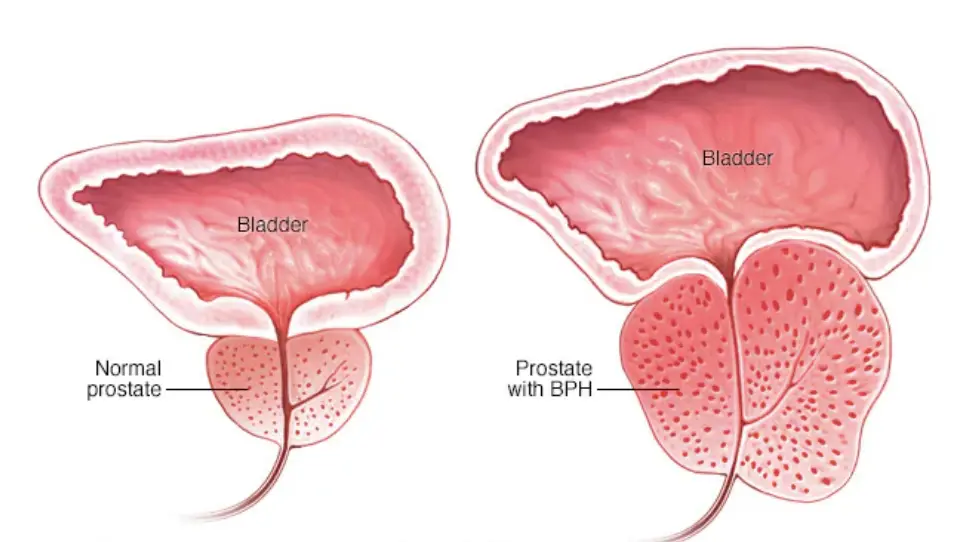
The prostate is a gland made of fibromuscular tissue and glands. It converts testosterone into DHT, its fluid forms part of the semen and helps sperm survive, and it helps prevent retrograde ejaculation (semen flowing back into the bladder). With age, the chances of both benign enlargement and cancer rise.
Enlargement and symptoms are two different things
BPH (benign prostatic hyperplasia) is strictly a term for what the tissue looks like under the microscope. It does not rise in step with LUTS (lower urinary tract symptoms), and these symptoms are often unrelated to the prostate or its size. When benign enlargement blocks the bladder outlet, we call it BPO (benign prostatic obstruction).
LUTS include a weak stream, straining and an interrupted flow; frequency, urgency, urge incontinence and getting up at night to pass urine; and dribbling or a feeling of incomplete emptying after passing urine. Most elderly men have at least one of these, from mild to severe, and they can impair quality of life.
Assessment starts with a full history, a symptom questionnaire (the IPSS, International Prostate Symptom Score), a frequency volume chart or bladder diary, and a physical examination including a digital rectal examination. Tests include urine, serum creatinine and PSA, an ultrasound of the bladder and prostate with the urine left after voiding, and uroflowmetry (a test of how fast urine flows).
The gap between tablets and TURP
Treatment runs from watchful waiting and lifestyle changes, through medicines, to surgery. Each year about 16% of men stop their prostate medicines, because of poor relief or side effects.
I think follow-up should move from "How are you doing?" to "Let's look at how you are doing", with the IPSS form used at every visit for every man over 45 with BPO. About 65% of patients who complete the IPSS survey say they are interested in an alternative to continuing medicines.
Medicines and TUR procedures (removing prostate tissue through a telescope) are two extreme ends. Patients who fail medicines need a procedure, every TUR procedure carries a risk of complications, and some patients are unfit for it. Minimally invasive methods fill that gap, though their results are not expected to match TUR, and many have been introduced and then become obsolete.
How the Urolift implants hold the channel open
The prostatic urethral lift, known as Urolift, suits patients who are unfit for, or do not want, a major procedure. It can be done under local or general anaesthesia.
Through a cystoscope (a telescope passed into the urethra), small permanent implants are placed to compress the lateral lobes that crowd the channel. Each implant has a nitinol tab that sits on the outer capsule of the prostate, a stainless steel end-piece in the urethra, and a PET suture joining them. The result is a continuous open channel along the front of the prostate.
The implants are placed in order. The first goes in the upper prostate, more than 1.5 cm from the bladder neck, and the second in the lower prostate, in front of the verumontanum (a small landmark near the sphincter). More are added between them if the channel is not yet continuous, and a median lobe (a middle lobe that bulges into the bladder) is treated if it is still obstructing.
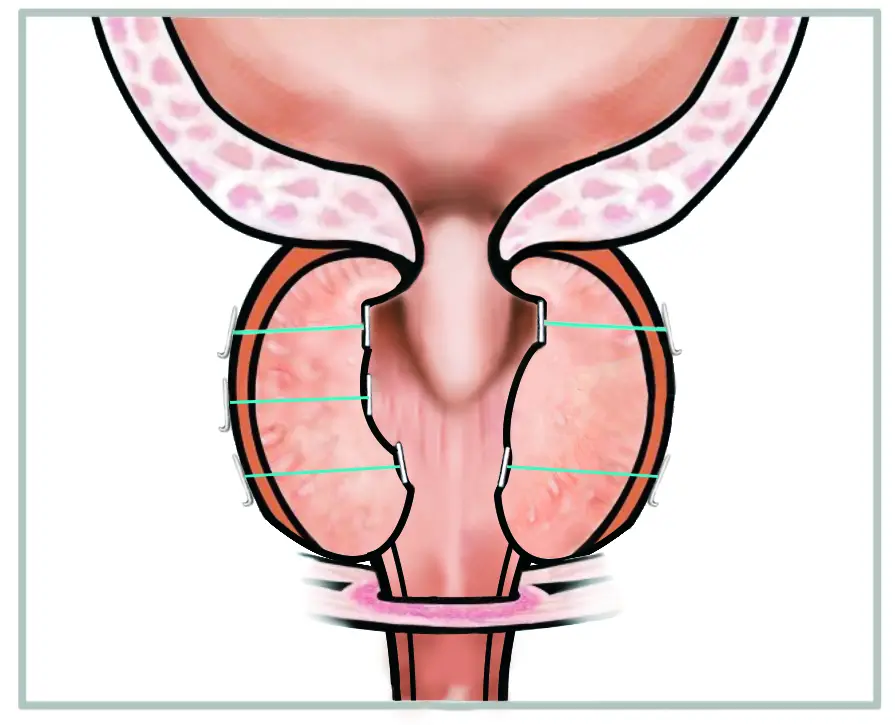
The procedure looks simple, but it needs proper training in the angle, the pressure and the point of release of each implant. The benefit lasts because the mechanical pull of the implants is combined with shrinkage of the compressed tissue over time, as Roehrborn and colleagues showed in 2017.
Who is a good candidate
Urolift is contraindicated for a prostate over 80 cc, a current urinary infection or visible blood in the urine, a urethra that will not allow the delivery system to pass, and incontinence due to a weak sphincter.
The EAU guideline of 2023 says the prostatic urethral lift improves symptom score, urine flow and quality of life, though these improvements are inferior to TURP at 24 months. It has a low rate of sexual side effects, and the guideline recommends it for men with LUTS who want to preserve ejaculation, with prostates under 70 mL and no middle lobe. The AUA guideline says urologists should consider it, and that for men concerned about new erectile or ejaculatory problems it likely adds no extra risk.
What it offers and where it falls short
The procedure takes about 10 to 15 minutes. The chance of ejaculatory problems is extremely low, and there are no known cases of erectile dysfunction. A catheter afterwards is not mandatory. It can be done under local anaesthesia with a nerve block in patients unfit for general anaesthesia, and in patients on aspirin. The stay is short, there are no major side effects, and a median lobe can be treated in some cases.
It is the only procedure that can be reversed if required, and the same or any other procedure can still be done in future. It can also be used in patients with retention of urine.
The most common complications are blood in the urine, pain on passing urine, pelvic pain, urgency, temporary leakage and urinary infection. Most are mild to moderate and settle within two to four weeks.
The shortcomings are a high-cost consumable, unsuitability for prostates over 80 g, and the need to combine it with resection when the bladder neck is very tight or the median lobe is very large.
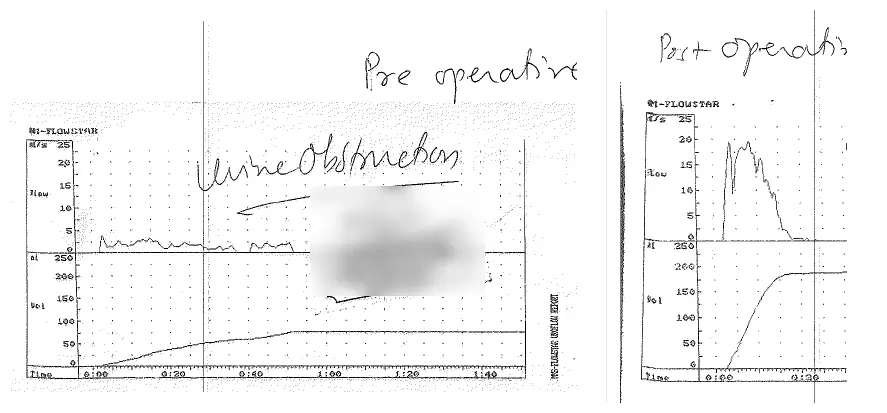
In the talk I showed urine flow tests from one of my patients. Before the procedure the peak flow was 3.8 mL per second. Afterwards it was 19.5 mL per second.