This talk was about prostate health for a general audience. I explained what the gland is and what it does, the problems it commonly causes, and what a urologist can offer when it enlarges.
A small gland in a busy spot
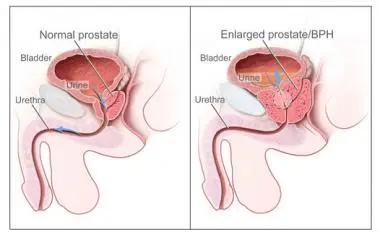
The prostate is a walnut-sized gland that sits between the bladder and the penis, just in front of the rectum. The urethra (the tube that carries urine out of the body) runs through the centre of the prostate on its way from the bladder to the penis.
That position explains why prostate problems so often affect urination. When the gland grows or becomes inflamed, it presses on the urethra that passes through it, and the flow of urine is affected.
The prostate's main job is to make a fluid that nourishes and protects sperm. During ejaculation the prostate squeezes this fluid into the urethra, and it leaves the body with sperm as semen. The vasa deferentia (the tubes that carry sperm from the testes) bring sperm to the seminal vesicles, two small glands that add their own fluid to semen.
The two common conditions that are not cancer
Prostatitis means inflammation of the prostate, sometimes caused by infection. It is typically treated with medicines that relax the prostate, antibiotics and pain relief.
The enlarged prostate is the other common condition. Doctors call it BPH (benign prostatic hyperplasia, meaning a non-cancerous growth of the gland). It affects many men over 50, and the difficulty passing urine tends to increase with age. Medicines or surgery can treat it.
Symptoms fall into two groups
The first group is obstructive, meaning the urine is being held back. Men describe difficulty starting, a weak stream, needing to strain or push, a flow that stops and starts, and a feeling that the bladder has not fully emptied.
The second group is irritative, meaning the bladder becomes restless. This shows up as passing urine often, a sudden urge to go, getting up at night to pass urine, and leakage before reaching the toilet.
An enlarged prostate that causes no symptoms usually needs no treatment. In that case we simply keep an eye on it, which is called watchful waiting.
A doctor can often feel an enlarged prostate during a digital rectal examination (a gloved finger placed in the rectum to feel the gland). A PSA blood test (prostate-specific antigen, a protein the prostate makes) may also be raised by an enlarged prostate, which is one reason a high PSA needs careful interpretation.
What treatment is trying to achieve
When symptoms are bothersome, the options are watchful waiting, medicines, and surgery, which may be minimally invasive or more invasive. Whatever we choose, the goals are the same. We want the man's quality of life to improve, which we measure with a symptom questionnaire called the IPSS (International Prostate Symptom Score). We want the urine flow to improve, which we measure with a uroflow test that records how fast urine comes out. And we want the fewest possible side effects from medicines and complications from surgery.
Two families of medicine are used. Alpha-blockers relax the muscles of the prostate so urine flows more freely. 5-alpha-reductase inhibitors lower a form of testosterone called DHT, which makes the prostate shrink and improves flow.
When surgery comes into the picture
Medicines usually settle the symptoms of an enlarged prostate, but some men need surgery to improve symptoms and prevent complications.
Surgery is considered when the enlarged prostate is causing complications: repeated blood in the urine, repeated episodes of being unable to pass urine at all, a bladder that stops working well, stones forming in the bladder, hydronephrosis (swelling of the kidneys from urine backing up), or repeated infections.
It is also considered when medicines are not working well enough. That includes symptoms that stay bothersome with a high IPSS score, a urine flow that remains low, side effects from the medicines, or simply the patient's own preference.
The minimally invasive methods I discussed were angioembolisation (blocking the small arteries that feed the prostate, done through a blood vessel), stents placed inside the prostate, TUNA (transurethral needle ablation, which uses needles passed through the urethra to treat the gland), TUMT (transurethral microwave thermotherapy, which uses microwave heat), HIFU (high-intensity focused ultrasound), and water vapour injection into the prostate tissue.
The more established operations depend largely on the size of the gland. TURP (transurethral resection of the prostate, removing the obstructing tissue through the urethra with a radiofrequency current) suits glands of about 30 to 80 grams. Medical lasers, such as thulium, holmium, green light and diode lasers, are another option. For glands larger than about 80 grams, the choices include open surgery, laparoscopic (keyhole) surgery and endoscopic enucleation, where the inner gland is shelled out through the urethra.
Cancer is a separate question
The same talk also covered prostate cancer, which is a different condition from BPH even though both can raise PSA. I have written about prostate cancer, its risk factors, testing and treatment choices in a separate post.
If you notice any change in how you pass urine, please see a urologist so the cause can be found and discussed with you.