The prostate is a walnut-sized gland between the bladder and the penis, just in front of the rectum. The urethra, the tube that carries urine out of the body, runs through the middle of it.
The prostate makes a fluid that nourishes and protects sperm. During ejaculation it squeezes this fluid into the urethra, where it leaves the body with sperm as semen.
Enlargement is common, and only symptoms need treatment
Benign enlargement of the prostate, called BPH, affects many men over 50. Difficulty passing urine tends to increase with age.
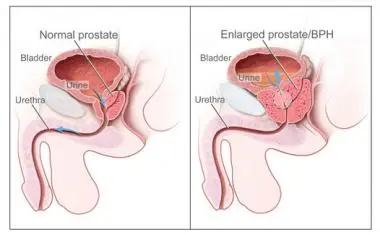
An enlarged prostate on its own, without urinary symptoms, needs no active treatment. For these men the approach is watchful waiting: keeping an eye on things and acting if symptoms appear.
The prostate can also become inflamed, which is called prostatitis. It is sometimes caused by infection and is usually treated with medicines.
Symptoms worth reporting
Some symptoms come from the blockage itself: difficulty passing urine, a weak stream, straining or pushing, a flow that stops and starts, and a feeling that the bladder has not emptied.
Others come from irritation of the bladder: needing to pass urine often, a sudden urge to go, getting up at night, and leakage before reaching the toilet.
What tests to expect
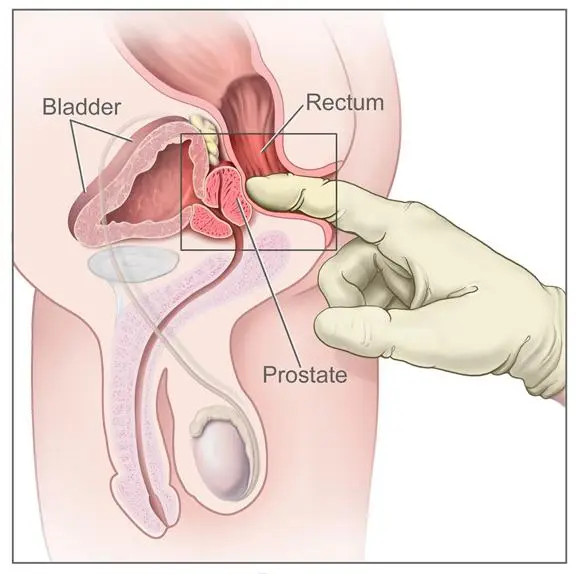
In a digital rectal examination (DRE), the doctor inserts a lubricated, gloved finger into the rectum and feels the prostate. It can sometimes detect enlargement, lumps that may be cancer, or tenderness from prostatitis.
The PSA test is a blood test for a protein the prostate makes. A high PSA makes prostate cancer more likely, but an enlarged or inflamed prostate can also raise it. Advice on whether and when to screen differs, so it is worth discussing with a urologist.
An ultrasound probe placed in the rectum gives a close view of the prostate. If cancer is suspected, a biopsy takes small samples of tissue with a needle, usually through the rectum.
The range of treatments
Treatment moves in steps: watchful waiting, then medicines, then surgery. Surgery can be minimally invasive or a larger operation.
I see medicines and TUR procedures (removing prostate tissue through a telescope passed up the urethra) as two ends of a range. Some men do not improve on medicines. Every TUR procedure has some risk of complications, and some men are not fit for a major operation. Minimally invasive treatments fill that gap, though their results are not expected to reach those of TUR, and many have come and gone over the years.
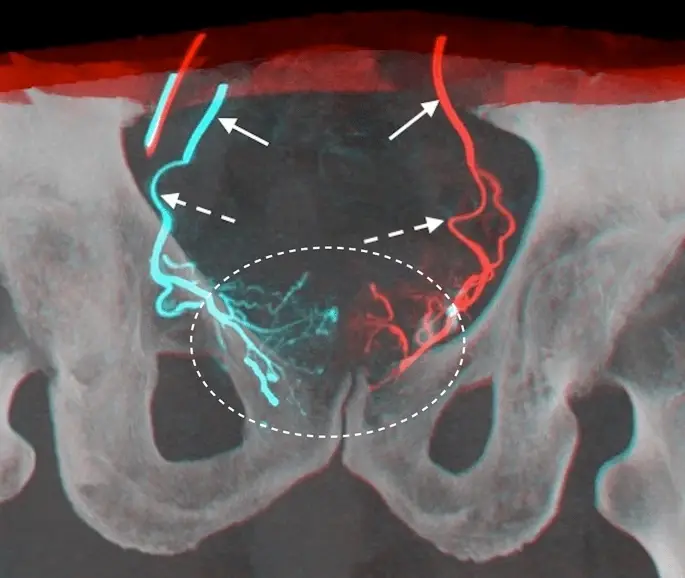
The procedures I covered were monopolar and bipolar TURP, Urolift, Rezum (steam treatment of the prostate), iTind (a small device placed in the urethra that presses the channel open), PAE (prostatic artery embolisation, blocking the blood vessels that feed the prostate), Aquablation (removing tissue with a water jet guided by ultrasound) and HoLEP (holmium laser enucleation of the prostate). Open removal of the prostate is the most invasive option.
A closer look at Urolift
In Urolift, small permanent implants are placed through a telescope to hold the enlarged side lobes of the prostate apart. This opens the channel without removing tissue, and the compressed tissue shrinks over time.
Its advantages are an extremely low chance of ejaculation problems and no known cases of erectile problems. A catheter afterwards is not always needed. It can be done under local anaesthesia with a nerve block in men unfit for a general anaesthetic, and in men taking aspirin. The stay is short and there are no major side effects. It is the only procedure that can be reversed, and any other procedure can still be done later.
It has limits. It is not suitable for a prostate over 100 grams, and it is not used during a urinary infection, with visible blood in the urine, or with leakage from a weak sphincter. A very tight bladder neck or a very large middle lobe may need resection as well, and the implants are costly.
A word on prostate cancer
Prostate cancer is the most common cancer in men apart from skin cancer, though only one in 41 men dies from it. Screening is tailored to each man's risk, age and family history. For early cancer, the choices range from careful monitoring to surgery or radiotherapy, and advanced cancer can be treated with hormone therapy or chemotherapy.
If you have any of the urinary symptoms described here, see a urologist so the cause can be found and the right option chosen for you.